
How to Verify a Math Answer Without an Answer Key
Going over the same work again can easily lead to the same mistake. Instead, use five quick checks that verify your answer from different angles and take only about two minutes.
You have solved the problem and written down an answer, but you are not sure whether it is correct. The answer key does not help either because it only includes the odd-numbered questions.
The obvious move is to solve the problem again, but that is not always a reliable way to check your work. If the first attempt contains an error, you may simply repeat the same mistake by using the same steps and reasoning. A better approach is to verify the result in a different way. Five simple checks can help, each looking for a different type of mistake, and together they take only about two minutes.
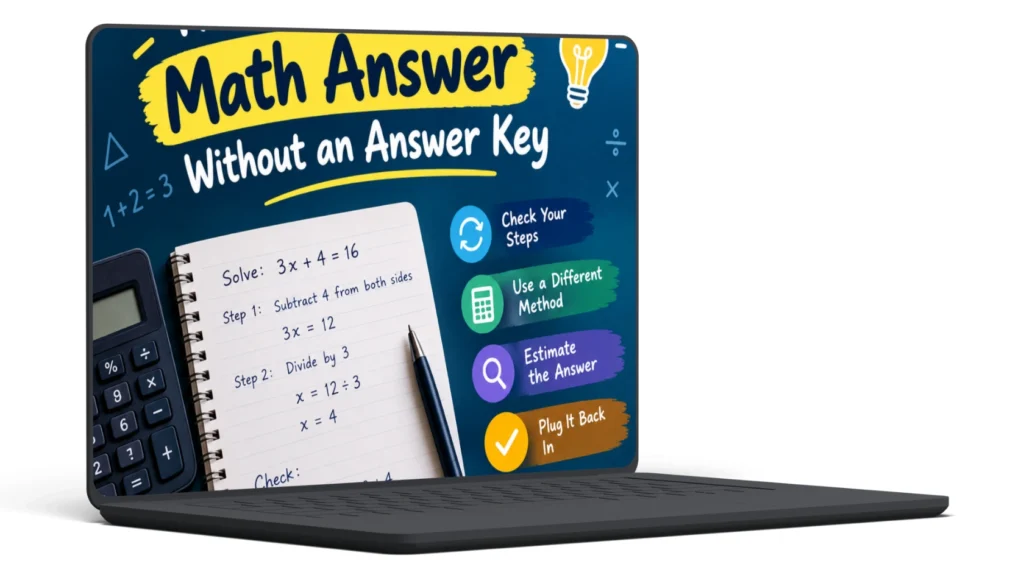
Plug Your Answer Back Into the Original Problem
Substitution is one of the strongest ways to check an answer because it compares your result directly with the original question. Instead of solving the problem again, put your answer back into the equation and see if it works.
For example, if solving 2x²−5x−3=0 gives x=3 and x=−1/2, substitute both values into the original equation. If each one produces zero, the answers are correct.
The key word is original. Always test your answer in the equation you were given, not a rearranged version. This is especially important when your steps involve squaring or other changes that can introduce extra answers.
For instance, solving x+6=x² may produce two possible values, but substitution into the original equation shows wh
Work Backward to Check Your Answer
You can often check a calculation by doing the opposite operation. Divide something? Multiply it back. Take a square root? Square the result. Factor an expression? Expand it again and compare it with the original.
This works especially well in calculus. If you find an integral, differentiate your result and check whether you get the original function. For example, if your answer is sin(x²)+C, differentiating it gives 2x cos(x²). If that matches the starting integrand, your answer checks out.
The same idea works with differentiation, although the reverse check can sometimes take more effort. The main point is to use a different operation to verify your result instead of simply repeating the same steps.
Estimate the Result Before You Compare
Before doing the calculation, make a quick estimate of what the answer should look like. It only takes a few seconds and can catch major mistakes early.
For example, with 47×19, rounding gives 50×20=1000, so the exact answer should be somewhere close to 1,000. The actual result is 893, which makes sense. If you got 89 or 8,930 instead, the estimate would immediately show that something went wrong.
Estimation may not prove that an answer is correct, but it is very good at spotting answers that are clearly wrong—even before you finish the problem.
Check the Units and What the Question Asks
There are two common mistakes to catch here: getting the units wrong and answering the wrong question.
First, check the units. If a problem asks for travel time but your answer is in miles, the calculation may be correct, but you found the wrong quantity. Your units should match what the question asks for.
The second mistake is easier to miss. You may calculate everything correctly but give the wrong result. For example, if the question asks how many more tickets were sold, giving the total number of tickets does not answer it.
This happens often in word problems. Before finishing, reread the final sentence and compare it with your answer. Ask yourself: Did I actually find what the question requested?
Use a Different Method to Solve It
George Pólya’s final step is to look back at your solution and ask whether the result can be checked in another way. This is one of the strongest checks because a different method is less likely to repeat the same mistake.
For example, after factoring 2x²−5x−3=0, use the quadratic formula as a second check. Both methods give x=3 and x=−1/2, confirming the result through two different approaches.
You can also use a graph. If x²=4x−3 gives x=1 and x=3, graph y=x² and y=4x−3. If they intersect at those values, your answer gets an independent visual check.
Take Two Minutes to Check Every Problem
You do not need to use all five checks every time. Make substitution and estimation your regular habits because they are quick and catch many common mistakes. For important questions, or whenever you felt unsure while solving, use a second method as well.
The bigger benefit is confidence. When you can check your own work, you do not have to depend completely on an answer key or som