
Factoring Calculator
Factor a polynomial using the appropriate pattern, then check your result by expanding it.
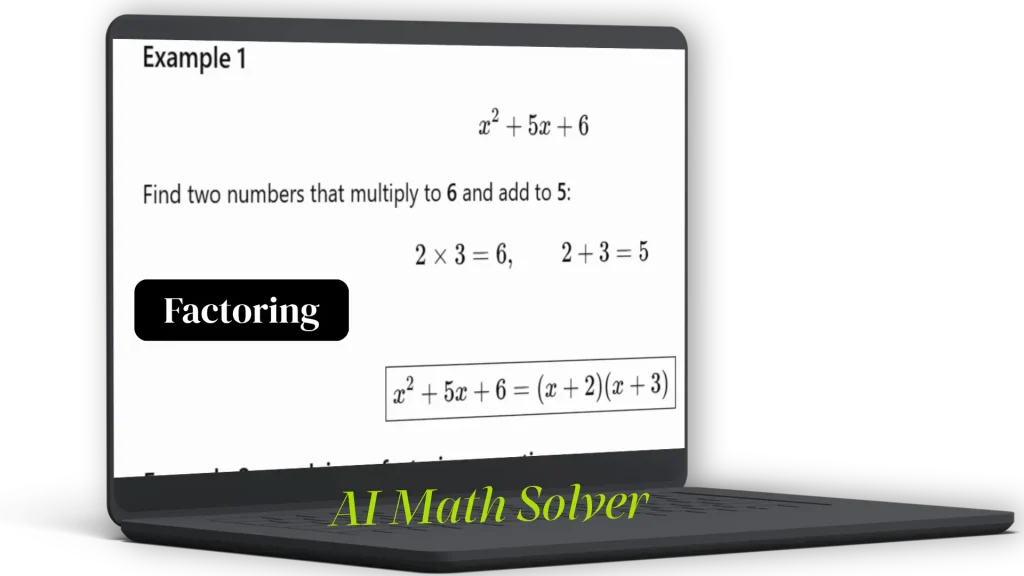
See How Factoring Calculator Undoes Multiplication
Rewrite a polynomial expression by expressing it as a product of simpler polynomial factors. This process, known as polynomial factorization, helps simplify algebraic expressions and makes solving quadratic equations easier. Start by identifying common factors, then consider the number of terms and their powers to determine which factorization methods apply.
A useful way to factor algebraic expressions is to look for patterns such as trinomial factorization, factoring by grouping, and special products. You can also work with rational factors when they exist.
A correct factored form should produce the original polynomial when its factors are multiplied together. Expanding polynomials afterward is a simple way to verify the result and catch sign errors.
Using the Factoring Calculator
Here is how to use factoring calculator:
Type in the Original Expression
Enter or paste the complete algebraic expression. You can also upload a clear photo or PDF and review the extracted text before solving. Whether you are working with quadratic expressions, binomial factors, or higher-degree polynomials, make sure the expression is entered correctly.
Follow the Steps Behind the Result
Each step is clearly broken down and explained, allowing you to compare the process with your own approach. These step-by-step factoring methods help beginners understand how common factors, polynomial factors, and other algebraic rules work together.
Explore Any Step You Find Unclear
Stay within the same solution to try another method, verify a restriction, or understand why a particular rule applies. This approach can help you simplify algebraic expressions and learn how to factor an expression completely
Recognizing a Difference of Squares
Some expressions follow recognizable patterns, including perfect square trinomials, the sum of cubes, and the difference of cubes.
For example, a perfect square trinomial follows the identity:
a² − b² = (a − b)(a + b)
Recognizing these patterns makes algebraic factorization faster and helps you choose the right method for each expression.
A Simple Method for Factoring Calculator Expressions
A reliable approach is to work through the following steps:
Find the Greatest Common Factor
Find the greatest factor shared by every term before trying any other factoring pattern. When learning how to find the greatest common factor, compare the numerical coefficients and the variables in each term.
For example, GCF factoring can simplify 6×2+12x6x^2+12x to 6x(x+2)6x(x+2). A common factor calculator can also help identify shared factors before you continue.
Factor Quadratic Trinomials
Choose terms that multiply to ac and add to b, then group them.
This method is especially helpful when factoring trinomials where the leading coefficient is not 1. It provides a systematic way to factor quadratic equations step by step when suitable integer factors exist.
Recognize Common Special Products
Some expressions follow recognizable patterns, including perfect square trinomials, the sum of cubes, and the difference of cubes.
For example, a perfect square trinomial follows the identity:
a2+2ab+b2=(a+b)2a^2+2ab+b^2=(a+b)^2
The difference of cubes follows this formula:
a3−b3=(a−b)(a2+ab+b2)a^3-b^3=(a-b)(a^2+ab+b^2)
Recognizing these patterns makes algebraic factorization faster and helps you choose the right method for each expression.
Worked Example: Factor 6x² + 11x -10
ac = 6 (-10) = -60 Find the product of leading coefficient and constant.
15+(-4)= 11 Find the factors of -60 that sum to 11.
6x² + 15x − 4x − 10 Break the middle terms into two terms.
3x(2x + 5) − 2(2x + 5) Factors each set of terms.
(3x-2) (2x+5) Take out the common binomial factor.
The complete Factorization is (3x-2) (2x+5)
Common Factoring Errors to Avoid
Here are some common factoring mistakes to watch for.
Overlooking the GCF
Factoring is incomplete when all the terms still contain common factors.
Mistaking a Sum of Squares for a Factorable Pattern
Unlike a² − b², a² + b² does not factor over the real numbers in the same way.
Forgetting to Check by Multiplication
Expanding the factors confirms the middle term and sign choices. It also helps identify mistakes before using the result to find polynomial roots or solve equations.
More Calculators to Try