
Chain Rule vs. Product Rule
Choosing between the chain rule and product rule is easier than it seems. Just ask what you would do last. This quick guide covers a five-second test, six examples, and three common mistakes to avoid.
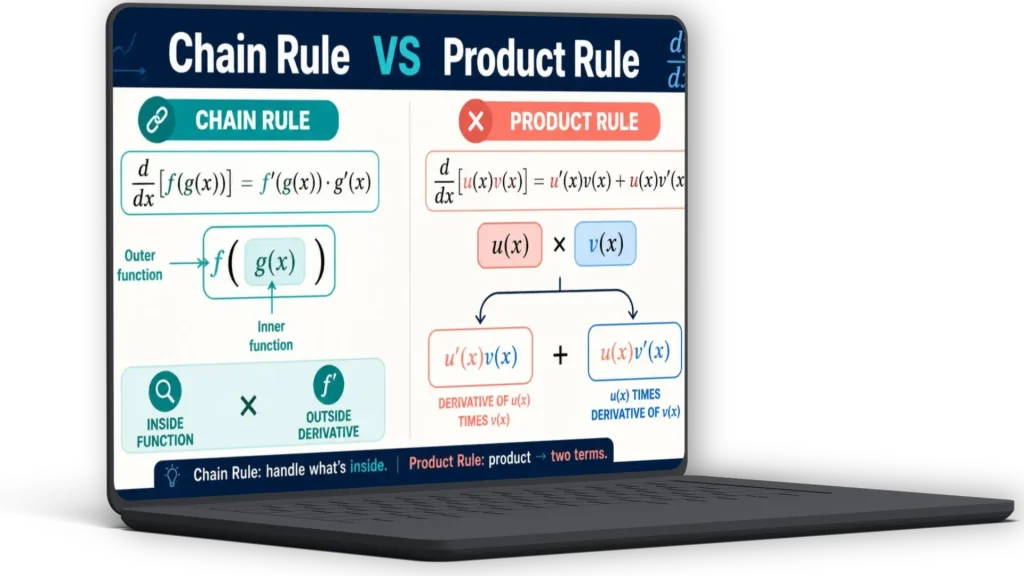
The Quick Check: What Would You Do Last?
Product Rule: When Two Expressions Are Multiplied
You need the product rule when a function has two separate factors multiplied together. Each factor can stand on its own as a function.
For j(x) = f(x)g(x), the product rule is:
j′(x) = f′(x)g(x) + f(x)g′(x)
In simple terms, differentiate the first factor and keep the second, then keep the first and differentiate the second.
A quick way to spot a product is to look at each part separately. In x²eˣ, you have x² and eˣ. Both make sense on their own, so they are two factors being multiplied—not one function wrapped inside another.
Chain Rule: When One Function Sits Inside Another
You are in chain rule territory when one function is placed inside another. There is an outside function and an inside function, and the inside part is not simply another factor.
For h(x) = f(g(x)), the chain rule is:
h′(x) = f′(g(x))g′(x)
In simple terms, differentiate the outside function first, keep the inside expression as it is, and then multiply by the derivative of the inside.
That final multiplication is easy to miss. In eˣ², for example, x² is the input to the exponential function, not a separate factor. So you differentiate the outer e function and then multiply by the derivative of x².
When a Problem Requires Both Rules
Some problems need both the product rule and chain rule, and this is where many students get stuck because they think they have to choose only one. You don’t. The last operation still tells you where to start, and the other rule can appear inside it.
Take x²sin(3x). The final step is multiplication, so start with the product rule:
2x sin(3x) + x²[derivative of sin(3x)]
The part inside the brackets needs the chain rule. The derivative of sin(3x) is 3cos(3x). Put it back into the product-rule result:
d/dx[x²sin(3x)] = 2xsin(3x) + 3x²cos(3x)
One rule handles the main structure, while the other takes care of the expression inside it.
The same idea works with nested chain rules. Take sin²(3x). The outermost operation is squaring, so start with that and get 2sin(3x). Then look at the expression inside: sin(3x). That needs the chain rule, giving 3cos(3x).
Multiply the two parts:
y = sin²(3x)
y′ = 2sin(3x) · 3cos(3x) = 6sin(3x)cos(3x)
The trick is simple: peel off one layer at a time. You don’t need to recognize every rule at once.
Six Common Functions You Can Identify at a Glance
Practice With Your Next Ten Questions
Do not work out the derivatives yet. Just write product or chain next to each function, taking only a few seconds for each one, and then check your answers. Identifying the structure is a different skill from applying the rule, and it is the skill that helps most when you are working quickly in an exam.
If you are unsure about an answer, do not focus on the final derivative. Instead, ask yourself why the function belongs to that rule. Try one with a step-by-step derivative walkthrough, then look at which operation was treated as the outermost one. This can clear up the confusion much faster than solving several similar problems.
The other topic calculators follow the same idea. Once you get used to looking at the last
amazing