
Fraction Calculator
With AI Math Solver Factoring Calculator helps break algebraic expressions into simpler factors, making equations easier to solve and understand. It can identify common factors and factor different types of polynomial expressions while showing the steps used to reach the result.
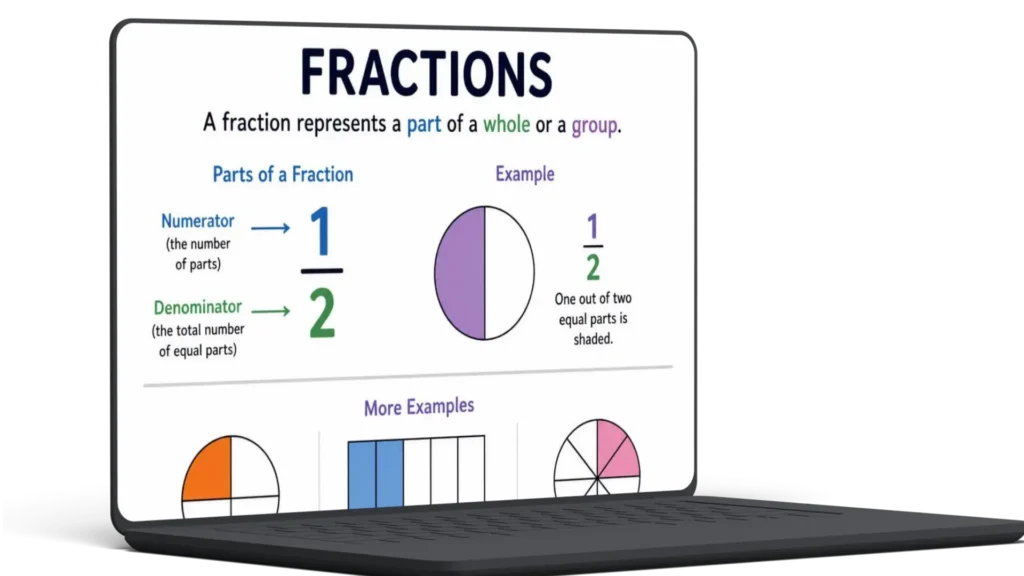
Work With Fractions Without Losing Accuracy
A fraction represents a numerator divided by a denominator that is not zero. Unlike a rounded decimal, it keeps the exact value intact through multiple calculations.
For addition and subtraction, fractions need a common denominator. Multiplication involves multiplying the numerators and denominators, while division means multiplying by the reciprocal of the second fraction. The final answer should be simplified until the numerator and denominator have.
Get Your Fraction Problem Solved
Type in the Complete Calculation
Enter or paste the complete expression. You can also upload a clear photo or PDF and review the extracted text before solving.
See How the Result Was Obtained
Each step is shown separately with an explanation so that you can compare it with your own approach.
Understand the Part You Are Stuck On
Stay in the same solution to try another method, verify a restriction, or ask why a rule applies.
Dealing With Fractions That Have Unequal Denominators
When fractions have different denominators, first find a common denominator before adding or subtracting them. Rewrite each fraction with the required equivalent denominator, combine the numerators, and simplify the final result if possible.
Cross-multiplication produces a common denominator. The resulting fraction may still need simplification.
Key Steps for Handling Fraction Calculations
Find a Matching Denominator
For addition or subtraction, convert both fractions to the least common multiple of their denominators.
Complete the Required Calculation
Multiply the numerators together and the denominators together. For division, change the second fraction to its reciprocal first.
Write the Result in Simplest Form
Find the greatest common divisor, then divide both parts of the fraction by it. Place any positive or negative sign with the numerator.
Things That Can Go Wrong With Fractions
Keep Denominators Unchanged When Adding
The denominator shows how many equal parts make up the whole. It should be matched with the other denominator rather than added.
Reverse a Fraction Only for Division
For division, invert the divisor—the second fraction—before multiplying.
Check Whether the Final Value Can Be Simplified
A calculation may be correct but still need simplification when the numerator and denominator have a common factor.